 Nexus mutual
 Cover Transitions and Completion Evidence
Nexus mutual cover transitions are complete only when the intended transaction agrees with the resulting protocol record. A successful transaction receipt proves inclusion, but not the resulting cover amount, latest cover ID, finalized claim outcome or payout redemption. For an edit, follow the original Cover NFT to its latest linked cover ID and read the updated fields. For a claim, separate submission, voting, cooldown, final outcome and payout redemption. For expiry, compare the start and period with the loss time, then treat allocation cleanup as a later accounting action. This keeps adjustment, redemption and exit evidence tied to the state each action changes.
Last updated
A confirmed transaction becomes meaningful only when the linked cover or claim record shows the intended state and final settlement.
From wallet request to changed protocol state
A cover purchase or edit begins with the terms shown before signing: the action, cover ID, amount, asset, period and maximum payment. Once submitted, the transaction receipt establishes whether the call succeeded. It doesn't establish that the resulting record matches the intention. A wrong cover ID can target the wrong record, while a stale quote may revert against live capacity or price constraints.
Completion therefore needs a second reading. Match the confirmed transaction to the returned cover or claim ID, then read that object's stored fields. For cover purchases and edits, the Cover NFT and cover data identify ownership and terms. For claims, the claim record and assessment state show whether submission, decision or redemption has occurred.
An interface can summarize those records, but its success message isn't the final evidence. The linked protocol state settles the question.
Edited covers and the newest linked ID
A cover edit changes the amount, period or both through the cover purchase function. The caller must own the Cover NFT or hold approval. Current capacity and onchain pricing still apply, so an edit uses a new quote rather than simply rewriting the old NFT in place.
Editing an existing cover creates a new cover ID and links it to the prior record. The original ID points toward the latest edit, while the latest record contains the terms that now matter. Reading only the first NFT can leave an earlier amount or period on screen.
The records that carry the edit
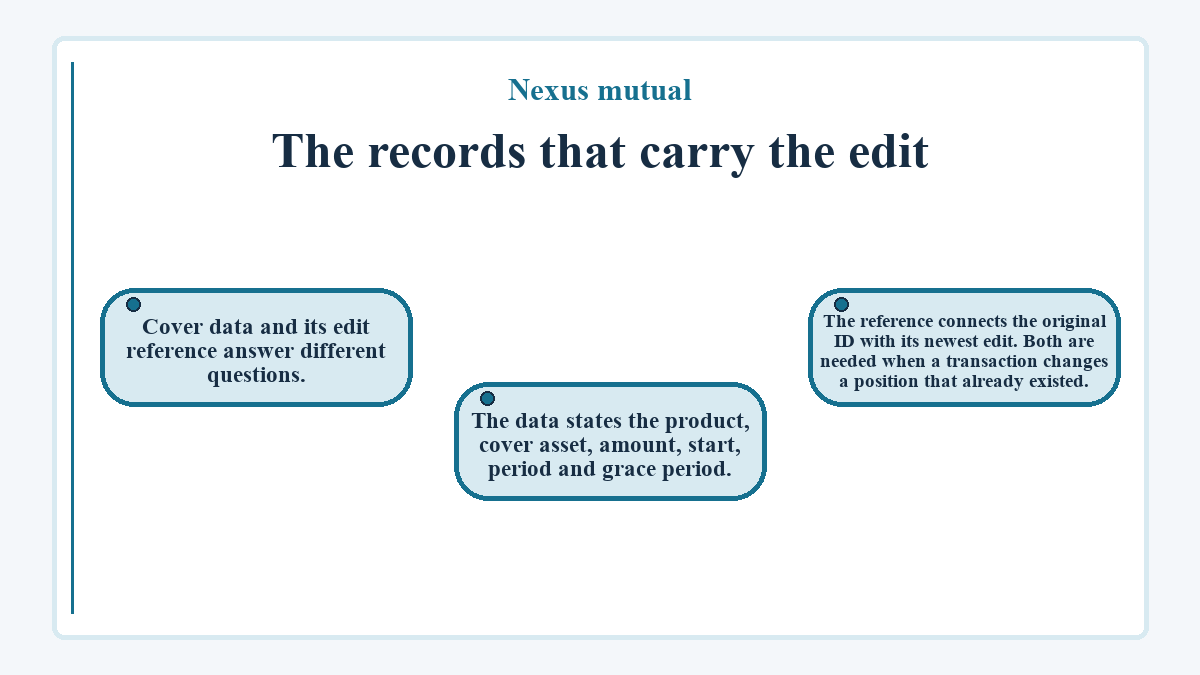
Cover data and its edit reference answer different questions. The data states the product, cover asset, amount, start, period and grace period. The reference connects the original ID with its newest edit. Both are needed when a transaction changes a position that already existed.
Current cover fields
The updated record should match the submitted amount and period after confirmation. Ownership should also match the intended NFT recipient. If those values don't agree, retain the transaction hash and compare the input with the latest linked cover data before attempting another edit.
Fee credit and pool compatibility
The remaining credit follows a narrower rule than the edit itself. It can apply to an updated period when the edited cover uses the same staking pool as the original purchase. The quote's pool allocation is therefore part of the decision, not an invisible implementation detail.
A hypothetical extension across two quote states
The cover amount of 18 ETH, proposed 148-day period and both quote allocations in this example are hypothetical. Assume the holder wants to keep the amount unchanged and extend only the period.
Compatible pool path
The first quote assigns the edit to the original staking pool. That compatibility permits remaining fee credit to be applied. Before signing, the holder checks the allocation and maximum payment. After confirmation, the new cover ID shows 18 ETH and a 12,787,200-second period, which equals 148 days, while the edit reference connects it to the original ID.
Changed pool edge case
The second quote routes the same requested edit to another pool because the live allocation differs. The remaining fee credit doesn't apply in that configuration. The holder stops before submission, leaving the original cover unchanged. A later compatible quote may support the intended edit, but only a confirmed transaction and newest linked record can establish it.
Private cover information has a separate trail
Extra Cover Info holds product-specific proof-of-loss details such as protected addresses or positions. This material is private and offchain, unlike the Cover NFT terms. Access requires a wallet signature that proves control of the address. That signature opens the record; it isn't a cover edit transaction and doesn't create a new cover ID.
A private update is complete when the saved information can be read back and matches the intended protected position. A successful onchain amount or period edit says nothing about that separate record. Changes remain available while cover is active and during its grace period, but the editing boundary closes once a loss event has occurred.
Claim submission, assessment and final outcome
Before payout, claim evidence changes at two stages: submission creates a case, while finalization establishes its decision. Neither state proves that a payout has been redeemed.
Submission establishes a claim record
A claim submission starts an assessment and creates a claim tied to a cover ID. Its stored record includes the requested amount, cover asset, payout redemption period and flags for payout or deposit retrieval. Submission events establish the claim ID and metadata entry, but they don't establish a decision.
Finalization establishes the outcome
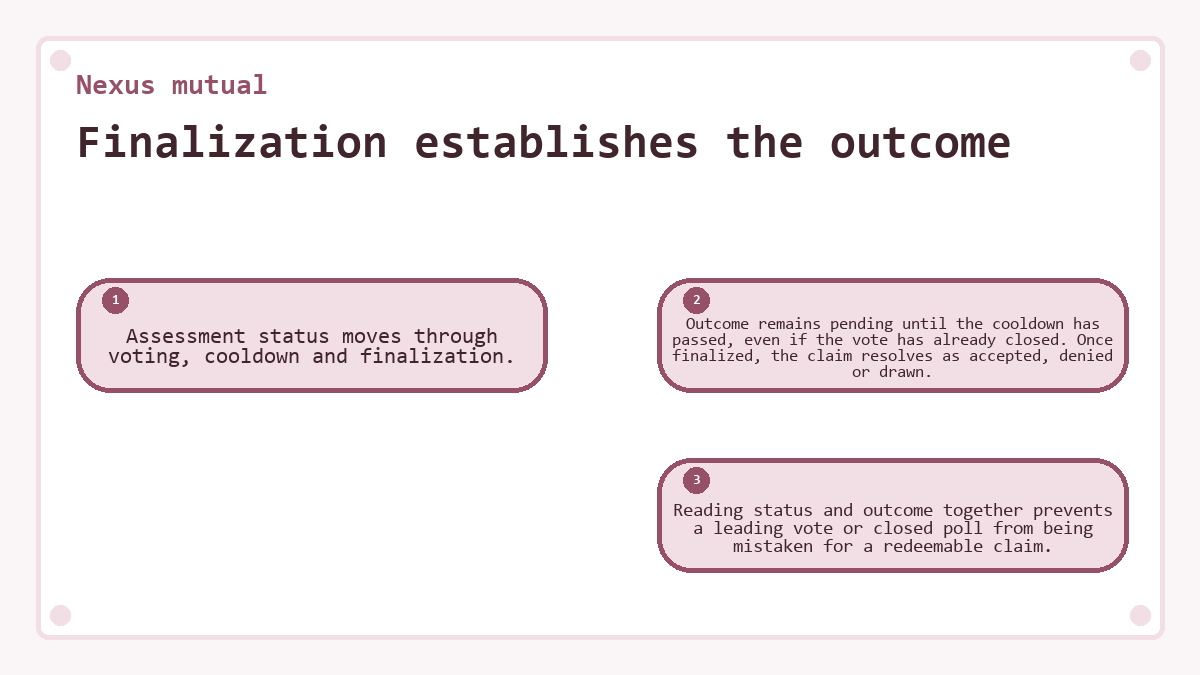
Assessment status moves through voting, cooldown and finalization. Outcome remains pending until the cooldown has passed, even if the vote has already closed. Once finalized, the claim resolves as accepted, denied or drawn. Reading status and outcome together prevents a leading vote or closed poll from being mistaken for a redeemable claim.
An accepted outcome opens a redemption step. It doesn't transfer the cover asset by itself, so the claim must still show that redemption is available and unexpired.
Redemption as the settlement checkpoint
A payout transition finishes when the accepted claim is finalized, its redemption window remains open and the redemption call succeeds. The protocol then burns the stake backing the claimed amount, sends the payout from the capital pool and returns the assessment deposit. The claim emits payout and deposit events and records that the payout has been redeemed.
Reconciliation should pair those records with the received cover asset. If the claim was partial, the current cover amount should be reduced by the redeemed amount while the remainder continues only for the existing cover period. An accepted decision without a redemption event is a right to redeem, while a redeemed flag and asset transfer show settlement.
Expiry and allocation cleanup mark different endings
Cover protection stops at the recorded end time. The grace period may still permit a claim for an eligible loss that occurred while the cover was active, but it doesn't extend protection to a later loss. A Cover NFT remaining in a wallet also doesn't change those dates.
Allocation cleanup happens after expiry. The expiry call deallocates cover from staking pools and updates active-cover accounting; it can't run before the cover has expired. A delayed cleanup call doesn't keep protection alive. End time governs the cover, while the later call reconciles protocol capacity.
Reconciliation that survives an interface change
A durable transition record joins the transaction with the state it changed. For a cover edit, retain the transaction hash, original ID, latest ID and updated terms. For a claim, retain the claim ID, final status, outcome, redemption event and received asset. Private Extra Cover Info needs its own signed readback because it isn't part of public cover data.
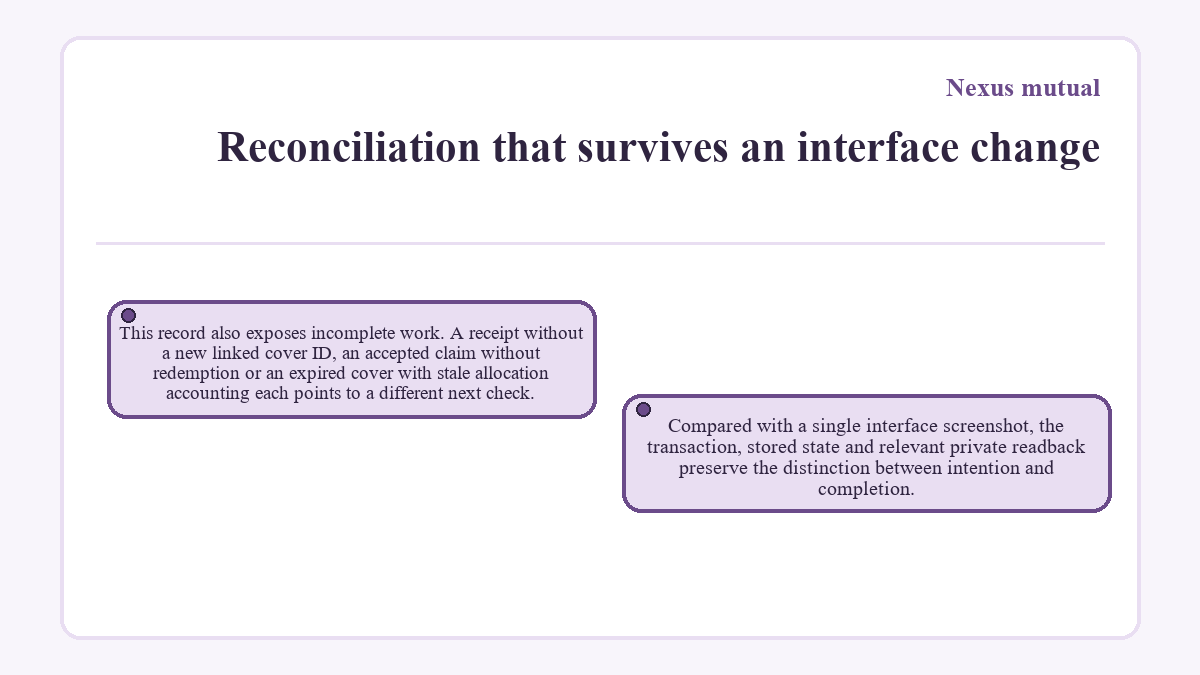
This record also exposes incomplete work. A receipt without a new linked cover ID, an accepted claim without redemption or an expired cover with stale allocation accounting each points to a different next check. Compared with a single interface screenshot, the transaction, stored state and relevant private readback preserve the distinction between intention and completion.
Still wondering about Nexus mutual?
Why can unused cover-fee credit change during an edit?
Unused cover-fee credit can change because it consists of NXM converted from the original fee at purchase. Later NXM price movement affects the credit applied to an edit. The edited cover must also draw capacity from the same staking pool for that credit to apply, so the new quote determines both eligibility and value.
Is payment-token approval enough to complete the cover update?
No. An ERC-20 approval lets the cover contract spend the payment asset, but it doesn't call the cover purchase function. Completion requires a separate successful purchase or edit transaction, followed by a Cover NFT or latest linked cover record whose amount, asset and period match the request.
What happens if a cover edit transaction reverts?
A reverted edit leaves the existing cover record unchanged and creates no new cover ID. The transaction can still consume network fees. Obtain a fresh quote before retrying because available capacity, pool allocation and onchain pricing may have moved since the failed attempt.
Can a signed renewal order be treated as active cover?
No. A renewal order is a signed instruction, not active cover. It can execute only within its renewal window, when the price is at or below the chosen maximum and a solver submits the purchase onchain. Active cover exists only after that transaction succeeds and the new Cover NFT and terms appear. Until then, rely on the existing cover's recorded end time.
What happens to the assessment deposit when a claim ends in a draw?
A drawn claim allows the assessment deposit to be retrieved rather than forfeited. The retrieval function may be called by anyone, but it sends the deposit to the current cover owner. Completion appears in the claim's deposit-retrieved flag and deposit event, not in the draw outcome alone.
Will calling expireCover remove the grace period for an eligible loss?
No. The expiry call removes expired allocations from staking pools and updates active-cover accounting. It doesn't rewrite the product's grace period. A claim may still be filed during that recorded grace period only for an eligible loss that occurred while cover was active.